It's probably not a good idea to be writing a blog post while I'm angry, but I can't seem to help myself. I won't give too many details because it'd be highly imprudent, but I think I can safely say that I had my worst experience of Japan tonight.
Given that I'm pretty much a non-drinker, I've never been particularly fond of the Japanese drinking culture, but after a year and a half I'm mostly OK with it. It definitely helps that basically all of the people that I see intoxicated on a regular/semi-regular basis are the type who just get happier, more chatty, or, at worst, slightly rowdy when drunk. I have no problem with that.
In fact, when I think more closely about it, I suspect that alcohol-inspired "friendliness/chattiness" probably goes a long way towards softening the rather off-putting effect of my natural reticence. That is to say, I seem to talk a lot more with people at events where alcohol is involved.
But I discovered tonight that I have no patience for people who become rude and obnoxious when drunk. It's been a long time since I gave myself a headache from sheer repressed rage (and the last time it happened it was from anger over an accumulation of small irritations built up over time), but it was pretty much an unavoidable consequence of being stuck in a vehicle listening to the loud, self-righteous complaints of a drunkard. For forty-five minutes I (and a handful of others) had to listen to this person complain about and criticize anything, everything, and everyone. Talk about being abused "past the endurance of a block!"
I'm usually a forgive-and-forget kind of person, but honestly, that's the kind of behaviour I can't simply dismiss as a mere drunken foible; it's a reflection on a person's character.
本当に最悪だ。
Friday, March 13, 2009


Tuesday, March 10, 2009
Most worthwhile purchases
Here are the most worthwhile purchases I’ve made since coming to Japan (in order of most to least expensive rather than importance):
 1. 1999 Toyota Vitz (¥350,000)
I didn’t realize how much I loved my car until I got into the accident and had to make the decision to junk it and get a new one rather than fixing it. It felt small but was big enough to fit five people. It handled really well and was quite fuel efficient. And I loved how cute and red it was! My K-car now is much more economical (I’m actually paying LESS insurance per month even after the accident!) but I don’t feel the same pride of ownership as with the Vitz when I look at it.
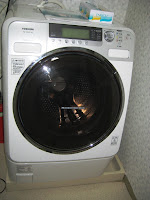 2. Toshiba TW-180VE SDD-Hybrid Drum Front-Loading Washer-Dryer (¥116,000)
I’ve always wanted a front-loading washer and dryer set, and now I have a front-loading washer-dryer! It’s awesome!! Granted, it takes more time overall to do my laundry than it would to do the same load size in Canada, but I love the time set function (i.e. I can put all my laundry in at night and program it to finish washing and drying the next morning) and all the different settings: dry clean, delicates, towels, etc. Basically, I just love it!! It was definitely the best purchasing decision I made when I was deciding what to buy for the apartment!
 3. Casio EX-Word (XD-SW6400) Electronic Dictionary (¥15,750)
I still can’t believe my luck in finding this at the Hard-Off. I use it almost everyday. The ability to input kanji by writing it with a stylus is indispensable!
 4. Kenkyusha Japanese-English Dictionary CD-Rom (Casio EX-Word DATAPLUS2 XS-KE04) (¥11,235)
The Kenkyusha dictionary is so much better than the Japanese-English dictionary that comes with the XD-SW6400! It has a LOT more entries and examples. I wouldn’t be a Hotaru no Hikari proof reader for J-SiS if I didn’t have this dictionary to check translations against.
 5. Kodansha Kanji Learner’s Dictionary SD Card (Casio EX-Word DATAPLUS3 XS-KD01CA) (¥7590)
This is an indispensable tool for learning the correct stroke order for writing kanji. Plus it’s a good back-up to have for those times when no matter how hard I try, I can’t get the proper kanji to show up when I write it by hand: with this I can look up the kanji by the stroke count, instead!
 6. LPD3213 Compact Fuji Lamipacker (A3) (¥6980)
When I got Christmas money from my parents in my first year (I stayed in Japan that year), I immediately decided to buy a laminator with it and I’ve never regretted the decision! I’ve made dozens upon dozens of flashcards with it—often late at night/in the wee hours of the morning. I can’t even begin to calculate how much time/gas/mileage I would’ve had to have used to drive to the office to do my laminating if I hadn’t made this wise investment early on in my time in Japan.
 7. Harmony Eupa Toaster Oven (TSK-2847N) (¥3980)
Most toasters in Japan don’t have temperature settings, just wattage settings, so I was really happy to have found this! I have made hundreds of cookies using this toaster. When I first bought it, I also had a lot of grilled cheese sandwiches and pizza toast for dinner!
 8. DVD Player (YTO-104) (¥3480)
It plays both R1 and R2 DVDs. My first year in Japan, I was pretty much the only Towada ALT to stay in Towada over the winter vacation, so the DVD player (and Tsutaya’s ¥100 rentals) was my best friend during that time!
 9. Miffy Slippers (¥780)
In Canada I was never a slipper-wearing person, but even in the apartment the floors get pretty cold, so it’s great to have warm, lined slippers to wear around the house! They also look a lot nicer/cuter than the old blue pair I bought at the ¥100 store when I was living in the old house.
 10. Onigiri Mould (¥105)
This probably saved me from many a dinnerless night when I first arrived in Japan! Even now, whenever I have to bring a bento to school or the office, I almost always make mayo-tuna onigiri. Sure, I could make the ongiri by hand, but using the mould is so much easier and faster (it takes about two minutes to make two).
 1. 1999 Toyota Vitz (¥350,000)
I didn’t realize how much I loved my car until I got into the accident and had to make the decision to junk it and get a new one rather than fixing it. It felt small but was big enough to fit five people. It handled really well and was quite fuel efficient. And I loved how cute and red it was! My K-car now is much more economical (I’m actually paying LESS insurance per month even after the accident!) but I don’t feel the same pride of ownership as with the Vitz when I look at it.
 2. Toshiba TW-180VE SDD-Hybrid Drum Front-Loading Washer-Dryer (¥116,000)
I’ve always wanted a front-loading washer and dryer set, and now I have a front-loading washer-dryer! It’s awesome!! Granted, it takes more time overall to do my laundry than it would to do the same load size in Canada, but I love the time set function (i.e. I can put all my laundry in at night and program it to finish washing and drying the next morning) and all the different settings: dry clean, delicates, towels, etc. Basically, I just love it!! It was definitely the best purchasing decision I made when I was deciding what to buy for the apartment!
 3. Casio EX-Word (XD-SW6400) Electronic Dictionary (¥15,750)
I still can’t believe my luck in finding this at the Hard-Off. I use it almost everyday. The ability to input kanji by writing it with a stylus is indispensable!
 4. Kenkyusha Japanese-English Dictionary CD-Rom (Casio EX-Word DATAPLUS2 XS-KE04) (¥11,235)
The Kenkyusha dictionary is so much better than the Japanese-English dictionary that comes with the XD-SW6400! It has a LOT more entries and examples. I wouldn’t be a Hotaru no Hikari proof reader for J-SiS if I didn’t have this dictionary to check translations against.
 5. Kodansha Kanji Learner’s Dictionary SD Card (Casio EX-Word DATAPLUS3 XS-KD01CA) (¥7590)
This is an indispensable tool for learning the correct stroke order for writing kanji. Plus it’s a good back-up to have for those times when no matter how hard I try, I can’t get the proper kanji to show up when I write it by hand: with this I can look up the kanji by the stroke count, instead!
 6. LPD3213 Compact Fuji Lamipacker (A3) (¥6980)
When I got Christmas money from my parents in my first year (I stayed in Japan that year), I immediately decided to buy a laminator with it and I’ve never regretted the decision! I’ve made dozens upon dozens of flashcards with it—often late at night/in the wee hours of the morning. I can’t even begin to calculate how much time/gas/mileage I would’ve had to have used to drive to the office to do my laminating if I hadn’t made this wise investment early on in my time in Japan.
 7. Harmony Eupa Toaster Oven (TSK-2847N) (¥3980)
Most toasters in Japan don’t have temperature settings, just wattage settings, so I was really happy to have found this! I have made hundreds of cookies using this toaster. When I first bought it, I also had a lot of grilled cheese sandwiches and pizza toast for dinner!
 8. DVD Player (YTO-104) (¥3480)
It plays both R1 and R2 DVDs. My first year in Japan, I was pretty much the only Towada ALT to stay in Towada over the winter vacation, so the DVD player (and Tsutaya’s ¥100 rentals) was my best friend during that time!
 9. Miffy Slippers (¥780)
In Canada I was never a slipper-wearing person, but even in the apartment the floors get pretty cold, so it’s great to have warm, lined slippers to wear around the house! They also look a lot nicer/cuter than the old blue pair I bought at the ¥100 store when I was living in the old house.
 10. Onigiri Mould (¥105)
This probably saved me from many a dinnerless night when I first arrived in Japan! Even now, whenever I have to bring a bento to school or the office, I almost always make mayo-tuna onigiri. Sure, I could make the ongiri by hand, but using the mould is so much easier and faster (it takes about two minutes to make two).
Saturday, February 28, 2009
Romance in the air
Before you get too excited, no, the title does NOT have anything to do with me personally! I just wanted a catchy title that would be applicable to two big February events: Valentine's Day and the wedding of one of the teachers at Kirita!
First, Valentine's Day. Like last year, I received a heck load of chocolates/cookies (most of which were homemade) from the girls at Kirita. Since Valentine's was on a Saturday this year, the school designated Monday (rather than Friday) as the celebration day. (This is a big difference between elementary school and junior high school: In elementary school, kids aren't allowed to bring Valentine's chocolate to school!)
Of course, Monday isn't my Kirita day, but luckily I was at Sawada Elementary School that day, so I didn't have to be at the school until about 10:15am. This enabled me to drive to Kirita to drop off the cookies for all the students and teachers (and even to help a bit with marking!) before I went to Sawada.
And since I wasn't there, I didn't have to sit at my desk labeling everything I received this year: Tomabechi-sensei did it for me! (Lucky for me, but I feel kind of bad for making extra work for her.) When I got to school on Tuesday, I had a big bag on my desk waiting for me.
 Of course I had to photograph every single one and write down who gave it to me when I got home. (The writing down the names was so I could give White Day presents to everyone who gave me something.) As I was photographing everything, I couldn't help but be impressed all over again with the care Japanese girls put into making their homemade chocolates.
In total, I got 19 Valentine's presents, 17 from students, 1 from a Kirita teacher, and 1 from Mukainakano-sensei. One student present was actually not from a Kirita student, but from a Kamikirida Elementary School student! I've taught at Kamikirida a couple of times so they all know me as the Kirita ALT (since the students usually go to Kirita for junior high school). Anyway, this particular girl is the younger sister of a sannensei girl and an ichinensei boy at Kirita. I happened to see the two girls in the Daiso on Saturday morning buying stuff to make Valentine's chocolate, so I guess that's why she (the younger sister) decided to make me something.


Basically the note says that she hopes I will enjoy the chocolates because she made them herself, and that my English classes are fun. ^_^
As always, you can see all the pictures of my Valentine's chocolates in my Facebook album.
Today (February 28th) was the wedding of Satou-sensei from Kirita. It was in Hirosaki so they chartered a bus to take everyone in the Misawa-Towada-Shichinohe area down. It was great not having to drive or to pay for a train down, but it was tough because I was so sleepy (we were supposed to be at the station by 9am and usually I sleep until noon on Saturdays, barring any engagements) and I didn't want to sleep because I was wearing contacts and I had my hair up in a bun. Towards the end of the ride, I did fall asleep, and regretted it because my eyes were SO dry, even after putting in eyedrops.
(Digression: I was pretty proud of my hair! I've never been able to figure out how to do anything more than a basic braid with my hair, but after looking through various hairstyle websites throughout the week, I finally figured out a style that would work on Wednesday night! Basically I pull my hair into a medium-high ponytail, twist it all up, tie it in a knot, and then wrap the remainder around the knot. It's the first time I've actually benefited from having super thin (quantity-wise) hair! Because I have so little hair, I was able to secure it all with just FOUR bobby pins!! No styling products, or even elastics were required to get it to stay up!)
Anyway, when we got the hotel, we loitered around in designated waiting areas until everything was ready to start. In Japanese weddings, the actual ceremony part (at the church/shrine/temple) is usually just for family, so the newlyweds and their parents were standing outside the doors to the banquet room greeting everyone. On the guests' part, we just bowed and said congratulations as we passed each couple. The bride and groom were wearing the traditional wedding kimonos (black for the groom, white for the bride). Plus the bride was wearing the traditional white wedding headdress--hard to describe, but I'm sure you can find a picture somewhere on the internet. It looked really heavy! The groom was bowing to everyone who greeted him, but it seemed like Satou-sensei could barely nod her head for fear of disturbing the headdress!
 When everyone was seated, the lights were dimmed, a spotlight was shining, and music was played with much fanfare for the entrance of first the groom and then the bride being escorted by her mother. The master of ceremonies gave brief introductions about the bride and groom, and then it was onto speeches from the principals of their respective schools (yes, they're both teachers), followed by the "kanpai" (toast). After that, the groom's mother performed a Japanese dance. Then the bride was led by her mother around the room before she exited to change dresses and everyone started eating.
At some point I'm guessing the groom also left to change, but I really didn't notice until Satou-sensei made her re-entrance in the Western style white wedding dress and veil. Again the lights were dimmed and the spotlight was on (making it hard to take any decent photos without flash), but this time she entered on the arm of her father. Her husband (now wearing a suit, so obviously he changed!) shook her father's hand before Satou-sensei rejoined him.
It was interesting because the wedding planning company's people were right there, prompting him to shake the father's hand! In fact, right from the beginning they were around, leading things! Even in during the first entrance, there was a guy walking in front of the groom (pacing him, I guess?) and a lady leading/helping the bride and her mother. I wonder if they had to have helpers they don't have wedding rehearsals like in Canada/America? (Besides, with both of them being teachers living in different cities hours away, it wouldn't have been practical for them to have a rehearsal.)
 Anyway, after the re-entrance they cut the cake and served each other bite. It was funny to notice that while the guy gave Satou-sensei a piece with strawberry, she just gave him a normal bite without any fruit! =P Following that they had a mini-procession of children (girls) carry bouquets which they presented to the couple. (I'm guessing that was a variation on the flower-girl?!) Then the "best man" and "matron of honour" (I doubt they're actually referred to as such in Japanese) made speeches, followed by presentations from the teachers at the groom and bride's respective schools.
He has been at the same school for six years, so the school presentation for him was pretty lengthy: a videotaped message from his students, the teachers' presentation, and a presentation from the baseclub he coaches. I felt kind of bad going after them with our Kirita presentation. We also had videotaped messages from each grade, but our teacher performance was less...energetic. We performed a popular song ("Kiseki" by Greeeen) on handbells. It sounded pretty good, but the mics didn't really pick it up, so I don't know if anyone other than the bride and groom and nearest couple of tables could even hear it. ^^;;
 When we returned to our seats, dessert was served and the bride left for yet another outfit change. When she returned, she was wearing a blue gown (symbolizing happiness, we were told) and she and her husband went around performing the candle ceremony.
I thought the candle ceremony was the neatest part of the wedding. On each table there was a candle on a fairly tall stand. The groom carried a giant lighter/torch-thing (don't know how else to describe it--it looked like a fencing foil with a flame coming out of the tip or something!) and they went to each table and lit the candle. I didn't really catch the full explanation (I was caught up in how lovely the effect was), but basically the candle ceremony symbolizes the bride and groom's appreciation towards the guests. I guess we have basically the same thing with the bride and groom walking around and toasting with all the tables, but with the lights once again dimmed and the spotlight on the couple, the effect was a lot more impressive than the toasting I'm used to. (Or maybe it's just because it was a novel concept to me?)
After that the bride made her thank you speech and the two of them walked from the head table to the doors where their parents were standing. They presented their new in-laws with flowers for the mothers and sake for the fathers (i.e. Satou-sensei gave the gifts to her husband's parents and vice-versa). Then the groom made his speech, and since they were so conveniently standing by the door, they exited right after that. After a few minutes, all the guests were invited to depart and we once again congratulated the newlyweds and their parents as we left.
Being so used to the Chinese church weddings (ceremony in the morning, sometimes followed by light refreshments, a break while the couple do the tea ceremony, and off to a banquet hall/restaurant for a dinner/dance) I was expecting my entire day to be spent at the wedding, so I was pleasantly surprised when we boarded the bus straight away and were back in Towada before 6pm!
It was definitely a good first experience of a Japanese wedding. Before the wedding I was kind of worried that there'd be a lot of Japanese wedding etiquette that I'd have to figure out from watching other people, but for the most part all I had to do was sit back and enjoy! And enjoy, I did--the food in particular! ^_~ You can see pictures of the food in my Facebook album.
 Then too I was quite pleased with how my outfit for the wedding turned out. When I went back to Canada for Christmas, I finally found a simple black dress that was actually fairly flattering on me! Luckily I knew I'd have the wedding to attend when I went back to Japan, so I brought it with me. Since it was fairly low cut and also short-sleeved, I went shopping last week to find a camisole to fill in the top a bit, and a cover-up of some sort. I lucked out and found exactly what I was looking for at Uniqlo! (I never realized how useful a nice stole can be until I found the one I got at Uniqlo! It doubled as a scarf when I was wearing my jacket!) Then I went jewelry shopping on Friday (I wanted some nice dangly earring and a necklace to balance out all the bare skin I was showing with my hair up and the cut of the dress) and found the perfect pieces (unfortunately you can't see them very clearly in the photo) at Chambre. ^_^
I don't know if it's just a matter of my sense of style improving with age/experience, or whatnot, but definitely since coming to Japan I've felt more like I can be at least passably pretty with a little bit of effort. And of course, losing a couple of kilograms is always provides a nice self-image boost (although I'm still not back to the weight I was at before going back to Canada for the holidays! =P). Anyway, I suspect that I'm going to be wearing the same outfit to pretty much every formal occasion I have to attend while I'm in Japan. ^_~ Well, maybe not to the graduation party since it'll be with all the same people from the wedding, but definitely for the ALT farewell party in June/July!
First, Valentine's Day. Like last year, I received a heck load of chocolates/cookies (most of which were homemade) from the girls at Kirita. Since Valentine's was on a Saturday this year, the school designated Monday (rather than Friday) as the celebration day. (This is a big difference between elementary school and junior high school: In elementary school, kids aren't allowed to bring Valentine's chocolate to school!)
Of course, Monday isn't my Kirita day, but luckily I was at Sawada Elementary School that day, so I didn't have to be at the school until about 10:15am. This enabled me to drive to Kirita to drop off the cookies for all the students and teachers (and even to help a bit with marking!) before I went to Sawada.
And since I wasn't there, I didn't have to sit at my desk labeling everything I received this year: Tomabechi-sensei did it for me! (Lucky for me, but I feel kind of bad for making extra work for her.) When I got to school on Tuesday, I had a big bag on my desk waiting for me.
 Of course I had to photograph every single one and write down who gave it to me when I got home. (The writing down the names was so I could give White Day presents to everyone who gave me something.) As I was photographing everything, I couldn't help but be impressed all over again with the care Japanese girls put into making their homemade chocolates.
In total, I got 19 Valentine's presents, 17 from students, 1 from a Kirita teacher, and 1 from Mukainakano-sensei. One student present was actually not from a Kirita student, but from a Kamikirida Elementary School student! I've taught at Kamikirida a couple of times so they all know me as the Kirita ALT (since the students usually go to Kirita for junior high school). Anyway, this particular girl is the younger sister of a sannensei girl and an ichinensei boy at Kirita. I happened to see the two girls in the Daiso on Saturday morning buying stuff to make Valentine's chocolate, so I guess that's why she (the younger sister) decided to make me something.


Basically the note says that she hopes I will enjoy the chocolates because she made them herself, and that my English classes are fun. ^_^
As always, you can see all the pictures of my Valentine's chocolates in my Facebook album.
Today (February 28th) was the wedding of Satou-sensei from Kirita. It was in Hirosaki so they chartered a bus to take everyone in the Misawa-Towada-Shichinohe area down. It was great not having to drive or to pay for a train down, but it was tough because I was so sleepy (we were supposed to be at the station by 9am and usually I sleep until noon on Saturdays, barring any engagements) and I didn't want to sleep because I was wearing contacts and I had my hair up in a bun. Towards the end of the ride, I did fall asleep, and regretted it because my eyes were SO dry, even after putting in eyedrops.
(Digression: I was pretty proud of my hair! I've never been able to figure out how to do anything more than a basic braid with my hair, but after looking through various hairstyle websites throughout the week, I finally figured out a style that would work on Wednesday night! Basically I pull my hair into a medium-high ponytail, twist it all up, tie it in a knot, and then wrap the remainder around the knot. It's the first time I've actually benefited from having super thin (quantity-wise) hair! Because I have so little hair, I was able to secure it all with just FOUR bobby pins!! No styling products, or even elastics were required to get it to stay up!)
Anyway, when we got the hotel, we loitered around in designated waiting areas until everything was ready to start. In Japanese weddings, the actual ceremony part (at the church/shrine/temple) is usually just for family, so the newlyweds and their parents were standing outside the doors to the banquet room greeting everyone. On the guests' part, we just bowed and said congratulations as we passed each couple. The bride and groom were wearing the traditional wedding kimonos (black for the groom, white for the bride). Plus the bride was wearing the traditional white wedding headdress--hard to describe, but I'm sure you can find a picture somewhere on the internet. It looked really heavy! The groom was bowing to everyone who greeted him, but it seemed like Satou-sensei could barely nod her head for fear of disturbing the headdress!
 When everyone was seated, the lights were dimmed, a spotlight was shining, and music was played with much fanfare for the entrance of first the groom and then the bride being escorted by her mother. The master of ceremonies gave brief introductions about the bride and groom, and then it was onto speeches from the principals of their respective schools (yes, they're both teachers), followed by the "kanpai" (toast). After that, the groom's mother performed a Japanese dance. Then the bride was led by her mother around the room before she exited to change dresses and everyone started eating.
At some point I'm guessing the groom also left to change, but I really didn't notice until Satou-sensei made her re-entrance in the Western style white wedding dress and veil. Again the lights were dimmed and the spotlight was on (making it hard to take any decent photos without flash), but this time she entered on the arm of her father. Her husband (now wearing a suit, so obviously he changed!) shook her father's hand before Satou-sensei rejoined him.
It was interesting because the wedding planning company's people were right there, prompting him to shake the father's hand! In fact, right from the beginning they were around, leading things! Even in during the first entrance, there was a guy walking in front of the groom (pacing him, I guess?) and a lady leading/helping the bride and her mother. I wonder if they had to have helpers they don't have wedding rehearsals like in Canada/America? (Besides, with both of them being teachers living in different cities hours away, it wouldn't have been practical for them to have a rehearsal.)
 Anyway, after the re-entrance they cut the cake and served each other bite. It was funny to notice that while the guy gave Satou-sensei a piece with strawberry, she just gave him a normal bite without any fruit! =P Following that they had a mini-procession of children (girls) carry bouquets which they presented to the couple. (I'm guessing that was a variation on the flower-girl?!) Then the "best man" and "matron of honour" (I doubt they're actually referred to as such in Japanese) made speeches, followed by presentations from the teachers at the groom and bride's respective schools.
He has been at the same school for six years, so the school presentation for him was pretty lengthy: a videotaped message from his students, the teachers' presentation, and a presentation from the baseclub he coaches. I felt kind of bad going after them with our Kirita presentation. We also had videotaped messages from each grade, but our teacher performance was less...energetic. We performed a popular song ("Kiseki" by Greeeen) on handbells. It sounded pretty good, but the mics didn't really pick it up, so I don't know if anyone other than the bride and groom and nearest couple of tables could even hear it. ^^;;
 When we returned to our seats, dessert was served and the bride left for yet another outfit change. When she returned, she was wearing a blue gown (symbolizing happiness, we were told) and she and her husband went around performing the candle ceremony.
I thought the candle ceremony was the neatest part of the wedding. On each table there was a candle on a fairly tall stand. The groom carried a giant lighter/torch-thing (don't know how else to describe it--it looked like a fencing foil with a flame coming out of the tip or something!) and they went to each table and lit the candle. I didn't really catch the full explanation (I was caught up in how lovely the effect was), but basically the candle ceremony symbolizes the bride and groom's appreciation towards the guests. I guess we have basically the same thing with the bride and groom walking around and toasting with all the tables, but with the lights once again dimmed and the spotlight on the couple, the effect was a lot more impressive than the toasting I'm used to. (Or maybe it's just because it was a novel concept to me?)
After that the bride made her thank you speech and the two of them walked from the head table to the doors where their parents were standing. They presented their new in-laws with flowers for the mothers and sake for the fathers (i.e. Satou-sensei gave the gifts to her husband's parents and vice-versa). Then the groom made his speech, and since they were so conveniently standing by the door, they exited right after that. After a few minutes, all the guests were invited to depart and we once again congratulated the newlyweds and their parents as we left.
Being so used to the Chinese church weddings (ceremony in the morning, sometimes followed by light refreshments, a break while the couple do the tea ceremony, and off to a banquet hall/restaurant for a dinner/dance) I was expecting my entire day to be spent at the wedding, so I was pleasantly surprised when we boarded the bus straight away and were back in Towada before 6pm!
It was definitely a good first experience of a Japanese wedding. Before the wedding I was kind of worried that there'd be a lot of Japanese wedding etiquette that I'd have to figure out from watching other people, but for the most part all I had to do was sit back and enjoy! And enjoy, I did--the food in particular! ^_~ You can see pictures of the food in my Facebook album.
 Then too I was quite pleased with how my outfit for the wedding turned out. When I went back to Canada for Christmas, I finally found a simple black dress that was actually fairly flattering on me! Luckily I knew I'd have the wedding to attend when I went back to Japan, so I brought it with me. Since it was fairly low cut and also short-sleeved, I went shopping last week to find a camisole to fill in the top a bit, and a cover-up of some sort. I lucked out and found exactly what I was looking for at Uniqlo! (I never realized how useful a nice stole can be until I found the one I got at Uniqlo! It doubled as a scarf when I was wearing my jacket!) Then I went jewelry shopping on Friday (I wanted some nice dangly earring and a necklace to balance out all the bare skin I was showing with my hair up and the cut of the dress) and found the perfect pieces (unfortunately you can't see them very clearly in the photo) at Chambre. ^_^
I don't know if it's just a matter of my sense of style improving with age/experience, or whatnot, but definitely since coming to Japan I've felt more like I can be at least passably pretty with a little bit of effort. And of course, losing a couple of kilograms is always provides a nice self-image boost (although I'm still not back to the weight I was at before going back to Canada for the holidays! =P). Anyway, I suspect that I'm going to be wearing the same outfit to pretty much every formal occasion I have to attend while I'm in Japan. ^_~ Well, maybe not to the graduation party since it'll be with all the same people from the wedding, but definitely for the ALT farewell party in June/July!
Wednesday, February 18, 2009
An ounce of prevention...
...is worth a pound of cure, as the saying goes.
So yesterday the sannensei had a test. This morning, my JTE showed me their marked test papers. Usually I skim through the answers to see where they had difficulties, but this morning I was kind of out of it (I'm really not a morning person!) so I barely glanced at the answers and mostly just looked at the scores.
Of course, it's Murphy's Law that the one time I do this, it's going to come back to bite me in the behind!
Anyway, we're going over the answers in class and there's one question where they have to make an appropriate response for a blank in a dialogue that goes something like this:
Mike: I think some of these books look very interesting.
Ken: _________________
Mike: OK. Thanks.
They have to fill in Ken's part using the word "want" in a sentence of 6 or more words. The answer my JTE had written down was "I will give some books to you, if you want." That was fine, but when she was explaining where students lost marks and how students could correct their answers, I realized that she had made a mistake in her marking of the answer.
My JTE was under the impression that the main difference between borrow and lend is that lending is more for matters involving money and/or institutions, while borrowing is more casual. But of course, the difference is much bigger than that. In the case of Person A "giving" something to Person B, the person lending is the owner/giver of the object (Person A), and person borrowing is the person who wants what Person A has (Person B). In Japanese, they also have different verbs to show this distinction--"kariru" for "borrow" and "kasu" for "lend"--and the usage is pretty much the same. That is, you either allow someone to borrow something or offer to lend something to someone. (Conversely, you have to ask permission to borrow something from someone or request that someone lend it to you.)
Anyway, it was fine that she wanted the students to use "borrow" so I didn't really say anything, but then I saw that a student who had written: "I will lend you some books, if you want"--a perfect answer!--didn't get full marks. I tried to explain the whole giver/receiver lender/borrower distinction at that point, but the discussion got stopped at "it's wrong because they haven't learned "lend" yet."
Fine, maybe penalizing a student for knowing more than they've been taught is a cultural difference in the educational system, but the problem is that the students were told it's OK to say "I will borrow you [something]." But of course, under NO circumstances could a person use that constrction in a grammatically correct way. (You could say "I will borrow you"--full stop--but that has a totally different meaning!) The correct way to use borrow in the above example would be: "You can borrow some books, if you want."
Being the "non-confrontational" type that I am, I was thinking about letting it slide, but really there's no way I can and still call myself a teacher. Besides, it was my fault for not checking the marked papers more carefully before class--which, unlike in the middle of class, would have been the appropriate time to have an extended discussion about the difference between "borrow" and "lend"--so it's up to me to broach the topic even if it's awkward for me to bring it up a full day later.
*sigh*
Yet again I've learned the importance of taking a little care beforehand to prevent trouble later on.
So yesterday the sannensei had a test. This morning, my JTE showed me their marked test papers. Usually I skim through the answers to see where they had difficulties, but this morning I was kind of out of it (I'm really not a morning person!) so I barely glanced at the answers and mostly just looked at the scores.
Of course, it's Murphy's Law that the one time I do this, it's going to come back to bite me in the behind!
Anyway, we're going over the answers in class and there's one question where they have to make an appropriate response for a blank in a dialogue that goes something like this:
Mike: I think some of these books look very interesting.
Ken: _________________
Mike: OK. Thanks.
They have to fill in Ken's part using the word "want" in a sentence of 6 or more words. The answer my JTE had written down was "I will give some books to you, if you want." That was fine, but when she was explaining where students lost marks and how students could correct their answers, I realized that she had made a mistake in her marking of the answer.
My JTE was under the impression that the main difference between borrow and lend is that lending is more for matters involving money and/or institutions, while borrowing is more casual. But of course, the difference is much bigger than that. In the case of Person A "giving" something to Person B, the person lending is the owner/giver of the object (Person A), and person borrowing is the person who wants what Person A has (Person B). In Japanese, they also have different verbs to show this distinction--"kariru" for "borrow" and "kasu" for "lend"--and the usage is pretty much the same. That is, you either allow someone to borrow something or offer to lend something to someone. (Conversely, you have to ask permission to borrow something from someone or request that someone lend it to you.)
Anyway, it was fine that she wanted the students to use "borrow" so I didn't really say anything, but then I saw that a student who had written: "I will lend you some books, if you want"--a perfect answer!--didn't get full marks. I tried to explain the whole giver/receiver lender/borrower distinction at that point, but the discussion got stopped at "it's wrong because they haven't learned "lend" yet."
Fine, maybe penalizing a student for knowing more than they've been taught is a cultural difference in the educational system, but the problem is that the students were told it's OK to say "I will borrow you [something]." But of course, under NO circumstances could a person use that constrction in a grammatically correct way. (You could say "I will borrow you"--full stop--but that has a totally different meaning!) The correct way to use borrow in the above example would be: "You can borrow some books, if you want."
Being the "non-confrontational" type that I am, I was thinking about letting it slide, but really there's no way I can and still call myself a teacher. Besides, it was my fault for not checking the marked papers more carefully before class--which, unlike in the middle of class, would have been the appropriate time to have an extended discussion about the difference between "borrow" and "lend"--so it's up to me to broach the topic even if it's awkward for me to bring it up a full day later.
*sigh*
Yet again I've learned the importance of taking a little care beforehand to prevent trouble later on.
Subscribe to:
Posts (Atom)


 Posts
Posts


